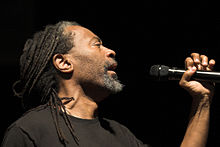
Born in the UK but raised in New York, he is the son of well-known operatic baritone Robert McFerrin. His song "Don't Worry, Be Happy" was a #1 U.S. pop hit in 1988 and won the Grammy for Best Song of the Year. McFerrin has also worked in collaboration with instrumental performers including pianists Chick Corea, Herbie Hancock, Joe Zawinul, and cellist Yo-Yo Ma. He is known for possessing a large vocal range of four octaves and for his ability to use his voice to create sound effects and in vocal percussion, like his recreation of a bass and drums simultaneously, which he achieves by singing while tapping on his chest. In addition to live vocal performances, he has created albums in which he is the only performer, singing and simulating instruments. He is also capable of throat singing--a practice common in central Asian countries such as Tuva and Tibet--in which the singer excites the natural overtones from the fundamental vocal pitch, producing a two-or three-part chord of notes from one voice.
In 1987, he sang the theme tune to The Cosby Show and soon after also provided the music for a Cadburys chocolate commercial.
In 1989, he composed and performed the music for the Pixar short film Knick Knack. The rough cut to which McFerrin recorded his vocals had the words "blah blah blah" in place of the end credits (meant to indicate that he should improvise). McFerrin spontaneously decided to sing "blah blah blah" as lyrics, and the final version of the short film includes these lyrics during the end credits.
In 1993, he also sang Henry Mancini's Pink Panther theme tune for the movie Son of the Pink Panther.
In addition to his vocal performing career, Mr. McFerrin was appointed in 1994 as creative chair of the Saint Paul Chamber Orchestra. He makes regular tours as a guest conductor for symphony orchestras throughout the United States and Canada. In his concert appearances, he combines serious conducting of classical pieces with his own unique vocal improvisations, often with participation from the audience and the orchestra. (For example, his concerts often end with McFerrin conducting the orchestra in an a capella rendition of the "William Tell Overture," in which the orchestra members sing their musical parts in McFerrin's vocal style, instead of playing their parts on their instruments.)
McFerrin also participates in various music education programs, and makes volunteer appearances as a guest music teacher and lecturer at public schools throughout the U.S. McFerrin has a son, Taylor, and father and son have collaborated on various musical ventures.